Before we can get started recreating folds in Schmidt’s net and interpreting them, we first have to know some basic terminology of them. I will try to keep this as short as possible, so…let’s start, shall we?
First and foremost, what is a fold anyway? A fold is a geologic structure in which one or several layers of rock are folded up due to an existing stress regime. For that to happen, the rocks must show some ductility, meaning they can be deformed.
Every fold has two sides. We call these the fold limbs (see Fig. 1). Imagine walking first up a hill chain and then down. These are the limbs.
If we stick at that example and you think about hill chains, you might remember one of the features that was described in a former post; namely vectors. Think about it; a hill chain more or less stretches in one direction and what is a direction in a coordinate system? Yes, a vector! As a result, a fold also has a directional vector. We call that the fold axis or hinge line (technically these are two different things but for now we can accept these both similar enough to mean the same). If you still have problems imagining that, picture yourself a towel hanging from a towel rack. The rack is the fold axis (see Fig. 1).
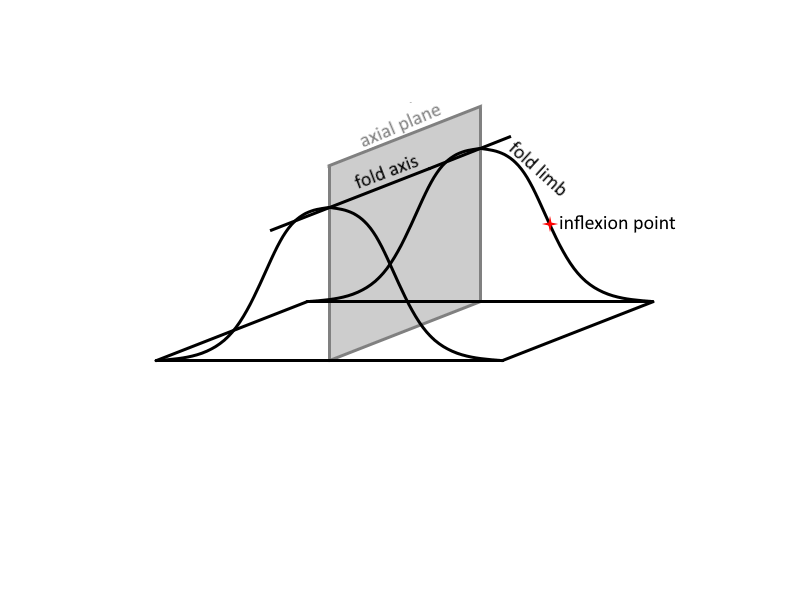
The fold axis itself is a part of the axial plane (grey plane in Fig. 1). In our case of a symmetrical fold, this plane seems rather useless, but if we are dealing with an asymmetrical fold, we can use the fold axis to determine the overall angle shape of a fold.
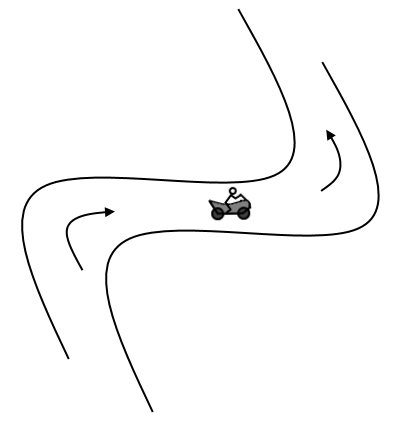
The shape of a fold limb can be described as a mathematical function, if we look at the limb in a cross-section. What is a feature of such a function? It possesses an inflexion point. What is that, you ask? The inflexion point is the point of steepest slope of a function. Picture you are driving a motorcycle (see Fig. 2) into a right-hand bend and after that comes a left-hand bend. What happens there? Well you first lean yourself to the right in the first curve, go back up and…stop, right there! You are in the vertical position again before leaning left. That is the inflexion point.
In addition to the axis plane, we also have the profile plane (see Fig. 3). As you could probably already guess, the fold axis functions as the normal vector for this plane.
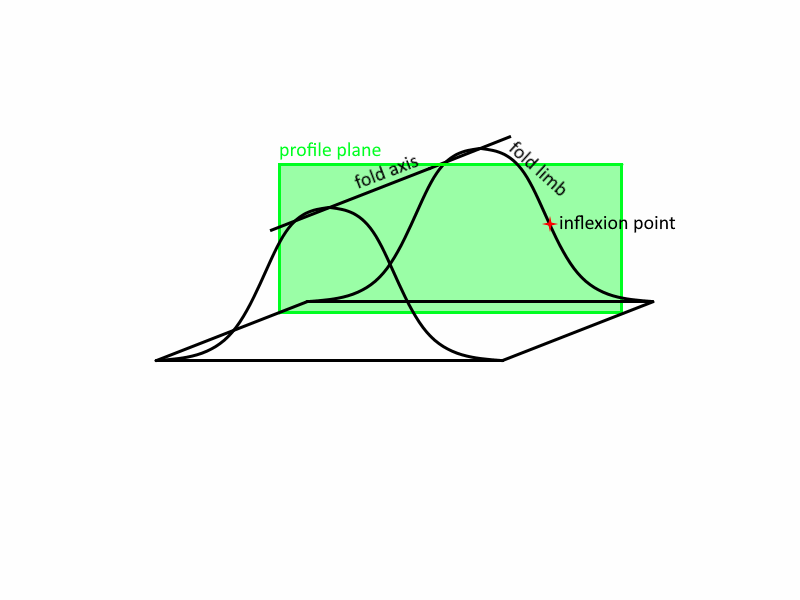
Instead of the axis plane you can now see the profile plane. This drawing however does not do that really justice; remember that the fold axis is perpendicular to the profile plane.
In nature you will see that often folds are intersected by faults perpendicular to the folds. These faults decouple the fold system, therefor reducing tension. You might not recognise its value now (and you don’t have to) but just know that this plane that will help us constructing folds in Schmidt’s net a lot.
And there we have it; all the necessary terms describe a fold.
 crazygeology